AI Companions and Real Relationships: Keeping Perspective
An adult AI chat platform is a text medium with a memory, and treating it as anything more ambitious than that is where most of the confusion starts. It does not replace the people in your life, and it does not pretend to: the content is AI-generated text, depicts no real person, and involves no video or images of anyone. What it does offer is a conversation that is always available, and the useful question is how much of your week you want that to occupy.

Key takeaways
- The platform states that its content is AI-generated text and depicts no real person, which settles what kind of thing a "companion" is here.
- The risk to watch is displacement, not attachment: the hours a habit takes are hours taken from something else.
- A working check is arithmetic. Three sessions a week at 25 minutes is 75 minutes a week, about five hours a month.
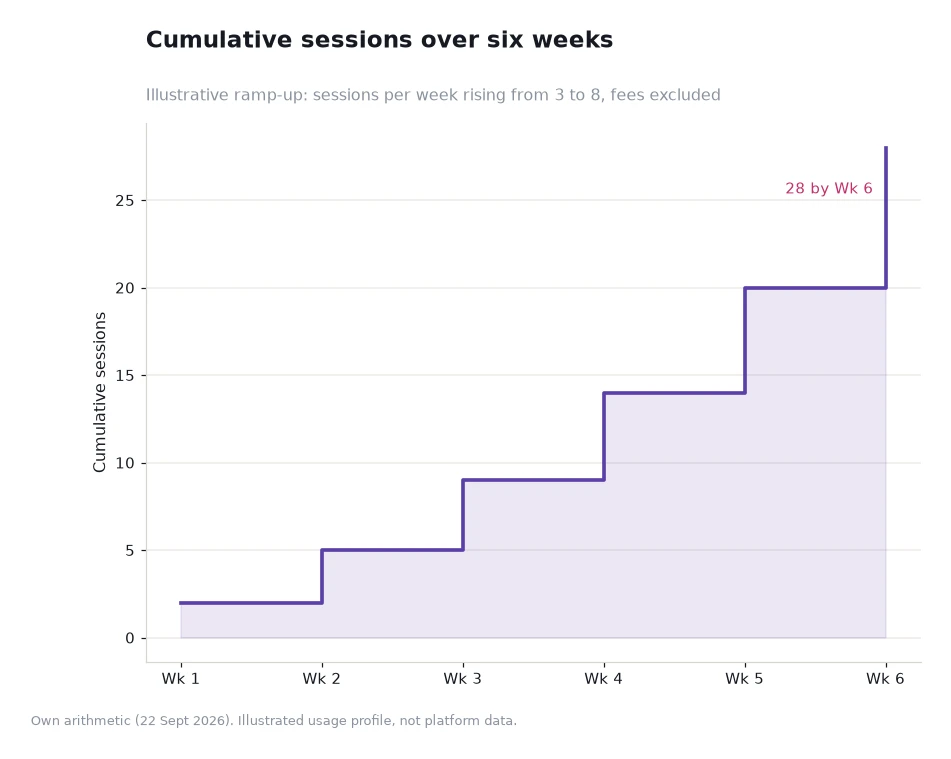
- Illustratively, six weeks of light use accumulate 28 sessions from weekly additions of 2, 3, 4, 5, 6 and 8.
What the platform is, and what it is not
Start with the factual frame because it removes most ambiguity. The operator publishes a compliance statement stating that content on the platform is AI-generated text, that it does not depict real people, and that the service does not produce images or video. Nothing in a session is a photograph of anyone, and no one is on the other end of the thread.
What the platform does provide is written conversation with continuity. Its own description of Sex AI companions emphasises replies that adapt to your personality and remember your preferences, wrapped in what it calls a private and secure environment. Continuity is the feature that makes the experience feel like a relationship, and it is also the feature that makes time use worth monitoring.
What it does not provide is reciprocity in the human sense. Every message you send is read by software; nothing that happens in a thread creates an obligation on either side, and no social cost attaches to closing the app. Recognising that is not cynicism, it is the reason the medium is restful — and the reason it should not be asked to do the work of a friendship.
Displacement is the number worth watching
Most honest discussions of adult AI platforms settle on displacement rather than attachment. A habit does not compete with your relationships directly; it competes for the hours in which those relationships happen. If an evening's chat replaces an evening's phone call, the effect is visible in the calendar rather than in the conversation.
That makes the useful unit of measurement a week, not a session. Two sessions become six, six become twelve, and each step feels small while the monthly total moves quickly. Setting the total deliberately — rather than discovering it in a summary — is the whole of the discipline.
A second check is behavioural rather than numerical. If you find yourself re-opening a conversation because you are avoiding something else, the platform is not the problem; it is the messenger. The same pattern shows up with games, streaming and social feeds, and it responds to the same fix: decide what the session is for before you start it.
| Dimension | What the platform offers | What it does not |
|---|---|---|
| Availability | Conversation whenever you open it | Someone waiting for you |
| Continuity | Replies that recall earlier interactions | A shared life outside the thread |
| Judgement | No social cost to anything you write | Another person's opinion, which is what makes human talk valuable |
| Disclosure | Controlled, because you decide what to send | The unplanned intimacy of a real conversation |
| Ending | You can close it at any point with no fallout | Anything that grows because you had to work for it |
Worked example
Two calculations are enough to keep the habit in proportion. The first is a time budget, and it is an illustration rather than platform data. Three sessions a week at 25 minutes each is 75 minutes a week. Multiply by four weeks and it becomes 300 minutes, about five hours a month. Double the frequency and the same sessions cost ten hours a month, which is roughly a working day's worth of evenings.
The second is the growth curve. Using the profile charted below, weekly additions of 2, 3, 4, 5, 6 and 8 sessions give cumulative totals of 2, 5, 9, 14, 20 and 28. Walk it through: week one ends at 2; week two adds 3 for 5; week three adds 4 for 9; week four adds 5 for 14; week five adds 6 for 20; week six adds 8 for 28. Half of the total arrives in the final two weeks, which is why a habit that feels mild in week two can look very different in week six.
Compare either figure with the alternatives it displaces. Five hours a month is about two evenings of television, or one book. That comparison is the point: the number is not alarming on its own, and it is only a problem if it is standing in for something you would rather be doing.
Keeping perspective without moralising
A practical rule is to keep the platform in one slot rather than letting it diffuse across the day. A fixed window — two evenings a week, or twenty minutes after work — makes the monthly total predictable and removes the small decisions that accumulate into a habit. Notifications are the main obstacle; turning them off converts the app from a source of prompts into a tool you open deliberately.
A second rule is to keep something else in the same slot's place. The point is not abstinence; it is that a routine with a counterpart is easier to sustain than a routine defined by what it excludes. Anyone wanting the platform's own account of what the product is can read the sex ai page, where Crushon sets out the adaptive and memory behaviour in its own words.
None of that requires treating the platform as a guilty pleasure. A conversation that is enjoyable, private and free of social cost is a reasonable thing to want, and the people who use it well are usually the ones who decided in advance how much of the week it gets. The NSFW AI trends board is a useful check on the same question from the other direction: it shows which listings other readers return to, week after week, which is the shape a sustainable habit takes.
Frequently asked questions
Is using an AI companion a substitute for relationships?
No. It is a text medium with memory and no reciprocity. The risk worth managing is displacement of time, not replacement of people.
How much time is too much?
That depends on what the time would otherwise hold. Five hours a month is modest; fifty is most evenings, and the arithmetic makes that visible before it becomes a habit.
Why does the conversation feel so continuous?
Because the platform stores context so replies can recall earlier interactions and adapt over time. It is a memory feature, not a relationship.
Decide the size of the habit first
Pick a slot, turn off notifications, and total up the month once. Then compare that total with whatever it replaced, and adjust from there.
Doing this once is usually enough, because the arithmetic is more persuasive than any guideline. This article is written for adults aged 18 and over.
Data and sources: platform wording on adaptive replies, remembered preferences and content status, read on 22 Sept 2026[1], together with the trend card counters used for the growth illustration's context. Session counts and monthly hour totals are illustrative assumptions and not platform data. Adults only, 18+.