Cold Mornings and Range: What Australian Drivers Notice
A frosty morning in Ballarat or a single-digit start in Hobart does not break an electric car, but it does change the arithmetic. XPENG publishes WLTP range of up to 525 km for the New G6 with a footnote that drives home the point: the figure depends on driving style, speed, passengers, load and temperature. Cold is simply one of those variables, and planning around it is easier than most first-time buyers expect.
Key takeaways
- Published WLTP range for the New G6 is up to 525 km, and the site notes it depends on conditions including temperature.
- Rapid charging moves the pack from 10 to 80 per cent state of charge in 12 minutes.
- Home charging includes a charging schedule, plug and charge and anti-theft locking.
- Scheduled maintenance stays on a 12-month or 20,000 km interval no matter how cold it gets.
What a cold morning changes, and what it does not
Two things happen on a cold start. The cabin needs heat, and the battery is at a temperature where it is less willing to accept or deliver energy than it was at 25 degrees. Neither is a fault; both are physics, and both are manageable with a routine.
What does not change is the car itself. There is no engine to warm up, no choke, no oil thick enough to slow a cold start. An electric car simply begins driving, which is why cold-weather complaints tend to be about range and comfort rather than about the drivetrain.
The published specification for the New G6 includes an 800V silicon carbide platform with 5C supercharging and a rapid charge window of 12 minutes from 10 to 80 per cent. That window is what protects a winter road trip, because a shorter stop in cold weather matters more, not less.
The WLTP footnote in plain words
WLTP is a standardised test, run under set conditions, and it exists so that two cars can be compared fairly. It is not a weather forecast. When the Australian pages say the up to 525 km figure depends on driving style, speed, passengers, load and temperature, they are telling you which levers you control.
Speed is the biggest of them. A cold morning on a suburban run with the heater on is gentler on the battery than a cold morning at highway speed with a headwind, because aerodynamic drag climbs with speed and the cabin is losing heat the whole way.
The practical instruction is simple. In winter, treat the published figure as an upper bound on a good day, and give yourself a margin before the next charge rather than planning to arrive with a thin reserve.
What the published details mean on a cold morning
| Cold-morning item | Published detail | What it changes |
|---|---|---|
| WLTP range | Up to 525 km, condition dependent | How much margin to leave in winter |
| Charge flap | Right rear quarter panel, press the top-left corner | Opening it comfortably with cold hands |
| Charger compatibility | Most Type 2 AC and CCS2 DC chargers | Options when a public charge is needed |
| Rapid charge window | 10 to 80 per cent in 12 minutes | How short a winter stop can be |
| Home charging features | Charging schedule, plug and charge, anti-theft locking | Charging overnight and leaving with a warm cabin |
Warming the cabin before you leave
In this example, assume you warm the cabin for ten minutes while the car is still plugged in at home, rather than heating it from the battery on the road. The logic is that energy from the wall is cheaper than energy from the pack, and you start the trip with a comfortable car instead of a cold one.
Treat that as a planning example rather than a published feature, and confirm the current behaviour of the Owner's App with your dealer before you build a routine on it. What is published is the charging schedule and plug and charge, both of which make a plugged-in overnight routine straightforward.
A windscreen cover left on overnight handles the rest. Ten seconds of work at seven in the morning beats ten minutes of demisting at seven fifteen.
Charging on a single-digit morning
The published guidance is that XPENG vehicles work with most Type 2 AC and CCS2 DC chargers, and that some Tesla Supercharger sites in Australia are open to non-Tesla CCS2 vehicles, with a check of the Tesla app recommended because not every site supports non-Tesla cars.
A cold pack takes energy more slowly at the very start of a rapid charge, so the first minutes of a winter stop are the slowest. The published 12-minute window from 10 to 80 per cent is the number to plan around, and leaving the car plugged in for a few minutes longer than usual on the coldest mornings is a reasonable habit.
Charging at home removes the problem entirely. Overnight on AC, the car has hours to reach a comfortable working temperature, and the schedule can be set to the low-cost hours on your plan.
Worked example: cold-weather range and five years of servicing
Two calculations are worth doing before winter. Both are illustrative, and the only published input in the first one is the WLTP range ceiling of up to 525 km for the New G6.
Assume cold conditions and winter tyres cost 15 per cent of usable distance. Then 525 x 0.15 = 78.75 km, and 525 minus 78.75 leaves 446.25 km, or about 446 km as an assumed cold-weather figure.
Next, remember that a rapid stop uses the published 10 to 80 per cent window, which is 70 per cent of a full charge. Applied to the assumed cold figure, 446 x 0.70 = 312.2 km, so roughly 312 km of range is added per stop. A 900 km winter drive then needs 900 divided by 312 = 2.88, so three stops, and three stops at 12 minutes each is 3 x 12 = 36 minutes of charging.
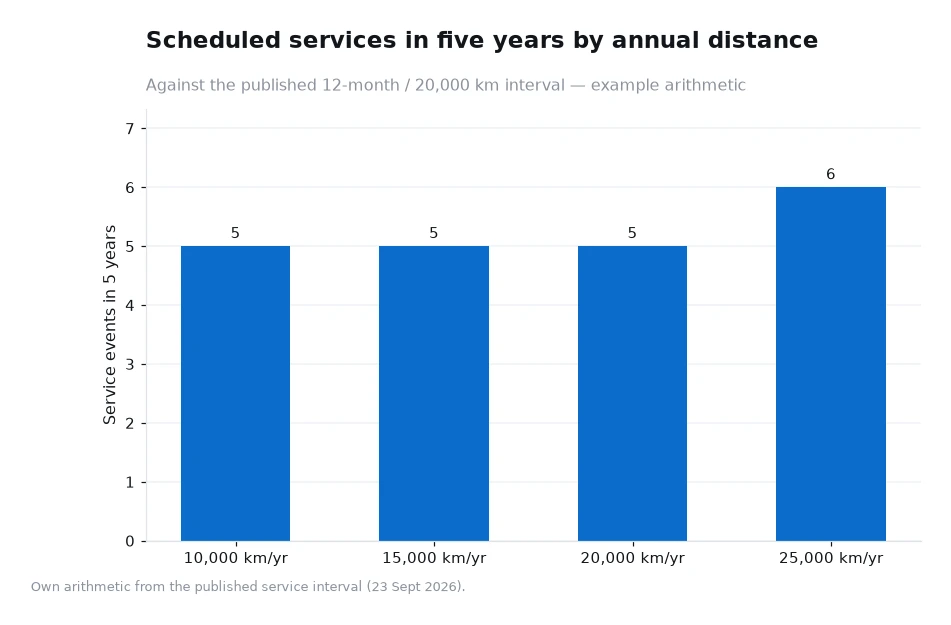
The service calculation uses the published interval of 12 months or 20,000 km, whichever comes first. At 10,000 km a year, five years is 5 x 10,000 = 50,000 km, and 50,000 divided by 20,000 = 2.5 on distance alone, but the calendar asks for five visits, so five. At 25,000 km a year, 5 x 25,000 = 125,000 km, and 125,000 divided by 20,000 = 6.25, so the sixth visit lands inside the fifth year. The chart below shows the same four cases.
Frequently asked questions
Does cold weather damage an electric car battery?
Cold reduces the rate at which a battery accepts and releases energy, and the published WLTP figure for the New G6 is stated to depend on temperature among other conditions. Reduced range on a cold morning is an operating characteristic rather than damage, and range returns as temperatures rise.
Should I charge to full every night in winter?
There is no published instruction to charge to full every night. The car includes a charging schedule, plug and charge and anti-theft locking, and the practical habit is to charge overnight on AC to whatever level suits the next day's driving, using the 12-minute 10 to 80 per cent rapid window for longer trips.
A routine for the first cold week
Charge overnight rather than chasing a public charger on the coldest morning. Set the schedule once through the Owner's App, leave the car plugged in, and let the cabin warm while it is still connected. Then drive the first ten minutes gently, because a cold pack and cold tyres are both working harder than they will at noon.
Keep a margin of at least a third of your usual range in winter, and check the published charging detail before a regional trip rather than during one.
The specification and charging guidance for the XPENG electric suv range is published on the manufacturer's Australian pages, including the charging overview and the Owner's App download page.
Range, charging and service details here come from the manufacturer's Australian site at xpeng.com/au, read on 23 Sept 2026, where WLTP range is stated to depend on driving style, speed, passengers, load and temperature, and conditions are set out in the XPENG ANZ Warranty and Maintenance Manual for Australia. The 15 per cent cold penalty, the ten-minute cabin warm and the annual distances are the author's own assumptions. [1]