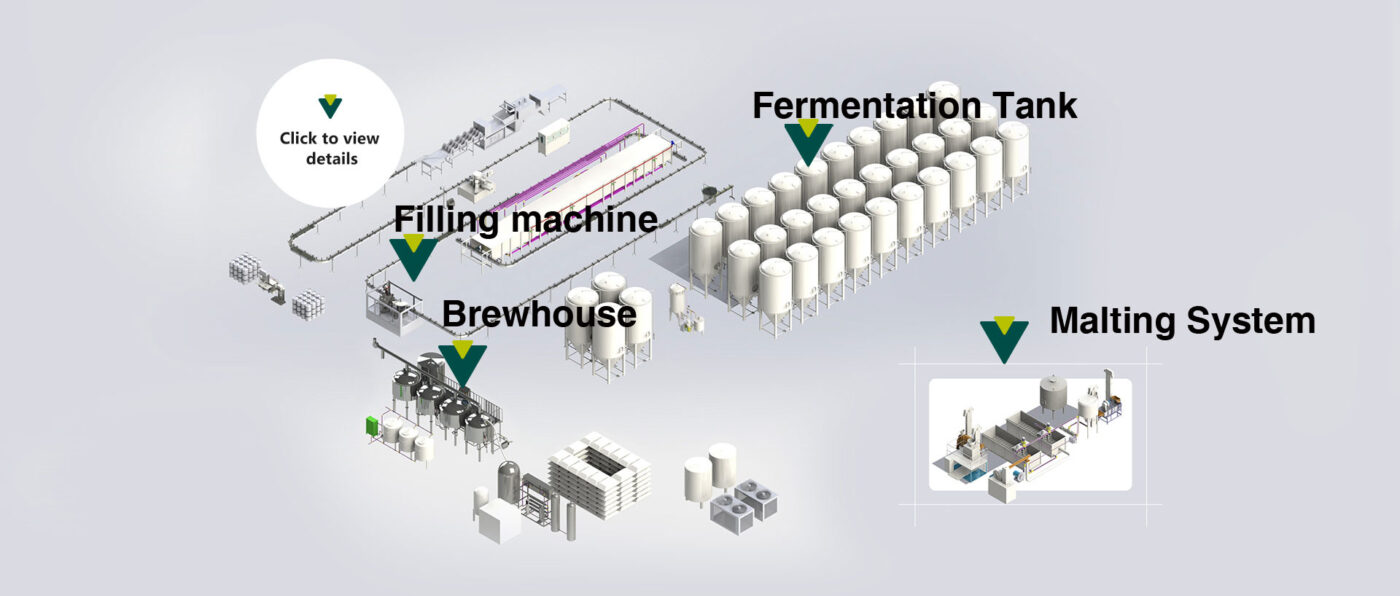
A turn-key brewery can be customized by matching vessel size, heating method, fermentation capacity, cooling demand, automation, packaging, and cleaning systems to the beer recipe and production schedule. A 10 hL brewhouse making two batches per day has different tank and utility needs from a 20 hL system brewing once daily. Ale fermentation commonly runs near 18–22°C, while many lager processes operate around 8–14°C and occupy tanks longer. Dry-hopped beer may require larger hop ports and better oxygen control. The equipment specification should come from batch volume, beer style, annual output, and cellar time rather than tank size alone.
Customization normally starts with the production calendar because nominal brewhouse volume says little about real annual capacity. A 10 hL system operated once per day for 250 brewing days can theoretically produce 2,500 hL of wort before process losses, while two turns per day can double that figure. Actual packaged output will be lower because wort, yeast, trub, transfers, filtration, and packaging remove part of the original volume.
Beer style changes how much cellar space that output needs. An ale that occupies a fermenter for 12–18 days can release tank capacity much faster than a lager held for 25–40 days, so two breweries producing the same 3,000 hL per year may need very different numbers of fermenters.
Cellar capacity is often more restrictive than brewhouse capacity because wort may be produced in hours while fermentation and maturation occupy a vessel for several weeks.
Brewhouse configuration should follow the number of daily turns. A two-vessel arrangement can work well for a smaller brewpub operating one or two batches, while three- or four-vessel systems make it easier to overlap mashing, lautering, boiling, and whirlpool operations. Production breweries trying to complete 4–6 turns within a working day usually need more vessel separation, larger hot-water capacity, and faster transfer steps.
The grain bill changes vessel geometry as well. A standard-strength ale around 11–14°P may fit comfortably within the intended mash volume, while a 20°P high-gravity beer can require substantially more malt per hectoliter. Allowing 15–25% freeboard in the mash vessel can help accommodate mixing, foam, and recipe variation without reducing the target knockout volume.
Lauter performance also depends on the ingredients. Barley malt forms a relatively stable grain bed, while recipes containing 30–50% wheat, oats, or rye can drain more slowly because those grains contribute different levels of husk material and beta-glucans. Larger false-bottom area, appropriate rake design, adjustable wort collection, and careful differential-pressure control can therefore matter more than simply increasing pump power.
The next equipment choice is heating. Small systems may use electric elements, while larger commercial breweries frequently use steam jackets because steam can provide high heat-transfer rates across a large vessel surface. A brewery planning three batches per day should calculate heating time, steam consumption, boiler capacity, and hot-liquor recovery together rather than selecting each component separately.
Energy recovery can reduce utility demand. Wort commonly leaves the kettle close to boiling temperature and passes through a plate heat exchanger before fermentation; incoming brewing water can absorb part of that heat and enter a hot-liquor tank. Depending on inlet temperatures and exchanger design, properly recovered heat can supply a substantial share of the hot water required for the next brew, reducing repeated heating during a 2026 production schedule.
Cooling calculations need the same level of detail. Fermenters do not all demand maximum refrigeration at the same time, but glycol equipment must handle periods when active fermentation, wort cooling, cold crashing, and cold-room use overlap. Crash cooling beer from about 20°C to 2–4°C places a very different short-term demand on the chiller than simply holding a finished tank at 2°C.
A practical glycol specification therefore includes ambient temperature, tank insulation, fermentation heat, crash-cooling time, pipe length, pump pressure, and future vessel additions. Reserving 15–30% extra distribution capacity may be reasonable when a brewery already plans another cellar row, although the correct allowance depends on the actual expansion plan rather than a fixed percentage.
Fermenter size should also match brewing frequency. A brewery using a 20 hL brewhouse may install 20 hL unitanks for maximum recipe flexibility, or 40 hL tanks if two brews will regularly be combined. Double batching lowers the number of tanks required for a given volume but makes production scheduling less flexible when several seasonal or low-volume beers are sold at the same time.
The fermenter specification can then be adapted to the beer itself. Typical options include multiple cooling jackets, pressure-rated construction, sample valves, racking arms, dry-hop ports, CIP spray devices, carbonation connections, pressure sensors, and independent temperature probes. A unitank designed for pressure fermentation also needs its maximum allowable working pressure confirmed before the control hardware is selected.
Hop-forward beer introduces another set of requirements. Dry hopping at rates around 5–15 g/L is common in many modern IPA programs, so a 40 hL fermenter may receive roughly 20–60 kg of hops in one addition. That volume affects port size, dosing equipment, tank headspace, mixing method, hop-removal practice, and final beer loss.
Oxygen management becomes more important after fermentation begins. Industry practice commonly aims to keep packaged dissolved oxygen at very low levels because oxygen accelerates staling reactions and can quickly change hop aroma. Breweries that package hoppy beer may therefore specify purged transfer lines, CO₂-compatible tanks, low-oxygen filling equipment, and closed transfers throughout the cold side.
beer brewing equipment should also be selected around cleaning procedures rather than treated as separate stainless-steel components. Tank diameter, spray-ball position, pump flow, return velocity, hose length, valve arrangement, and chemical concentration all influence how easily the system can be cleaned between batches.
CIP design becomes especially important as the number of tanks increases. A brewery with 4 fermenters can often manage cleaning with a relatively simple mobile arrangement, while a facility operating 12–20 cellar vessels may benefit from dedicated caustic, rinse, and recovery tanks. Chemical suppliers commonly specify caustic concentrations in the approximate 1–3% range for brewery applications, although temperature, soil type, contact time, and material compatibility determine the final procedure.
Cleaning capacity should be included in production planning because a fermenter cannot receive the next batch until cleaning, rinsing, inspection, and preparation are complete.
Water treatment can also be built into the turn-key package. Brewing water may require activated carbon, softening, reverse osmosis, mineral dosing, or simple filtration depending on local water chemistry. Calcium, chloride, sulfate, alkalinity, sodium, and pH all affect mash behavior and flavor perception, so equipment selection should follow a laboratory water report instead of a generic filtration package.
Automation is another area where customization can be measured rather than described as simply manual or automatic. A small brewery may automate only temperature control and pump speed, while a larger plant may add motorized valves, recipe steps, level measurement, flow meters, automated water dosing, and CIP sequencing. In a facility producing 5 or more brews per day, reducing repeated manual valve changes can save significant operator time.
Automation also improves repeatability when measurements are recorded consistently. Mash temperature, wort volume, original gravity, knockout temperature, fermentation temperature, tank pressure, and cleaning cycles can be logged through a PLC or brewery management system. A difference of even 1–2°C during mash or fermentation can affect attenuation, flavor development, or process time, depending on the yeast and recipe.
Packaging must be sized from actual sales format. A taproom selling 70–80% of production through draft may need only modest keg-cleaning and filling capacity, while a distribution brewery selling most beer in cans may require a dedicated canning line, accumulation space, date coding, pack-off equipment, and larger bright-beer capacity.
Filler speed should match both tank size and labor. A line running 30 cans per minute produces about 1,800 cans per hour before stoppages; a 60-can-per-minute line doubles the nominal rate but also requires faster depalletizing, pack-off, quality checks, and finished-goods handling. Buying a faster filler without matching upstream and downstream equipment can leave much of the rated capacity unused.
The building layout should be engineered at the same time as the equipment list. Ceiling height, door size, floor loading, drainage slope, steam or electrical service, glycol routes, ventilation, CO₂ distribution, compressed air, wastewater, and forklift access can affect equipment dimensions before fabrication begins. A 40 hL fermenter may fit the floor plan but still be impossible to install if roof clearance or doorway dimensions are insufficient.
Utilities deserve numerical checks before installation. Water use varies widely with cleaning practice and packaging, but many breweries consume several liters of water for every liter of beer sold. Reducing rinse time, reusing suitable recovery water, improving CIP control, and repairing leaking valves can lower the water-to-beer ratio without changing the beer recipe.
Expansion planning should focus on components that are difficult to replace later. Extra glycol main capacity, electrical allowance, floor drains, utility headers, tank connections, and physical cellar space can be inexpensive during the initial 2026 installation compared with modifying a crowded brewery after production has started.
Oversizing every component is not necessary. A better specification can reserve 20–30% space for additional fermenters while buying pumps, packaging equipment, and automation appropriate to present production. Future equipment can then be added where sales justify it without paying for unused capacity from the first brew.
The supplier should receive a detailed production brief before producing drawings or quotations. Useful information includes batch volume, brews per day, brewing days per year, annual production target, original-gravity range, maximum grain bill, fermentation time, conditioning time, dry-hop rate, package mix, utility supply, available floor area, ceiling height, and planned expansion.
A request for “a 20 hL brewery” leaves most engineering questions unanswered. A request for a 20 hL brewhouse running two turns per day, with 40 hL double-batch fermenters, 10 g/L maximum dry hopping, 60% canned sales, lager capacity, and 25% cellar expansion provides enough information to size vessels, cooling, water, controls, packaging, and utilities around the beer rather than around a catalog package.