How Chinese Brewery Equipment Manufacturers Compare on Warranty Terms
Warranty terms are the part of a brewery quotation that buyers read last and argue about first. The wording published by one Chinese manufacturer, Hermann Biological Engineering, is specific rather than broad: 6 years on tank accessories and electronic components against manufacturing defects from the factory, provided they are used within the scope. Read that sentence carefully and it tells you what is covered, what is excluded and what you have to document yourself.
Key takeaways
- The published cover runs 6 years and names two categories only: tank accessories and electronic components.
- The cause in scope is a manufacturing defect from the factory, and the condition is use within the scope, so installation damage sits outside it.
- Every tank carries a data plate with its pressure-testing record and serial number, which is the evidence a claim is built on.
- Delivery is quoted at 90 to 150 days from deposit to door, and after-sales is published as 7x24 with sales and engineers online around the clock.
What the published wording actually says
Compare quotations on the sentence, not on the adjective. The published Hermann wording covers tank accessories and electronic components for 6 years, against manufacturing defects from the factory, provided the parts are used within the scope. Three limits are built into that sentence and all three are normal in this industry: the duration, the categories of part in scope, and the cause of the failure.
That is a narrower promise than a headline number suggests and a more useful one than a vague promise of support. Accessories and electronics are exactly the parts that fail first in a working brewery: probes, controllers, valves and the small components that a packaging line, a chiller or a control cabinet depends on. The vessel shells themselves are covered by a different argument, because the evidence of their quality is the pressure test and the fabrication inspection, not a service life claim.
Terms that are easy to compare and terms that are not
Most manufacturers publish a duration. Far fewer publish how the clock starts, which parts the clock applies to, or what documentation a claim needs. When two quotations both say six years, the useful comparison is the sentence around the number.
| Element | Published wording | What to settle in writing |
|---|---|---|
| Duration | 6 years | The date the clock starts and how it is recorded |
| Parts in scope | Tank accessories and electronic components | Which items on your order count as accessories |
| Cause in scope | Manufacturing defects from the factory | How a suspected defect is diagnosed and reported |
| Condition | Used within the scope | What the scope document contains and who holds it |
| Evidence | Data plate with pressure-testing record and serial number on every tank | That plates are photographed and filed on arrival |
Traceability is the other half of a warranty
A warranty is only as good as the paper trail behind it, which is why the shipping and inspection routines matter as much as the wording. Every shipment passes five inspection steps: materials checking, production process, jacket pressure testing, packing and loading inspection, and a finished-product leak test. The inspection record travels with the order, and each tank carries a data plate with its pressure-testing record and serial number.
The practical result is that a buyer in another country holds two things a claim needs: a serial number that identifies the vessel or the assembly, and a documented test result for it. Few things slow a cross-border claim down more than a description of a fault with no identifier attached. Photograph the plates on the day the container is opened and the problem disappears.
Service wording that sits next to the warranty
The manufacturer publishes a 7x24 after-sales service and says that sales and engineers keep 24 hours online. Read that as availability of a channel rather than as a promise about response times: it means a brewery in a different time zone can reach a person during its own working hours, which matters when fermentation is running and a chiller is misbehaving.
That distinction deserves its own line on a comparison sheet. Ask when the channel is staffed, who answers it, and whether the person who answers can reach the design office. A brewing project that stalls on one controller in the middle of a fermentation costs far more than a slow reply about a spare part, and the published service wording is specific enough to be tested against those questions before an order is placed.
Buyers comparing suppliers should also weigh what happens before the warranty is ever needed. Design support, installation and commissioning, operator training, maintenance support and spare parts supply are the published services, and a supplier who trains the local team well usually generates fewer claims than one who ships and leaves. The published delivery window of 90 to 150 days from deposit to door is a good moment to book training, because commissioning follows delivery rather than the order date.
Worked example
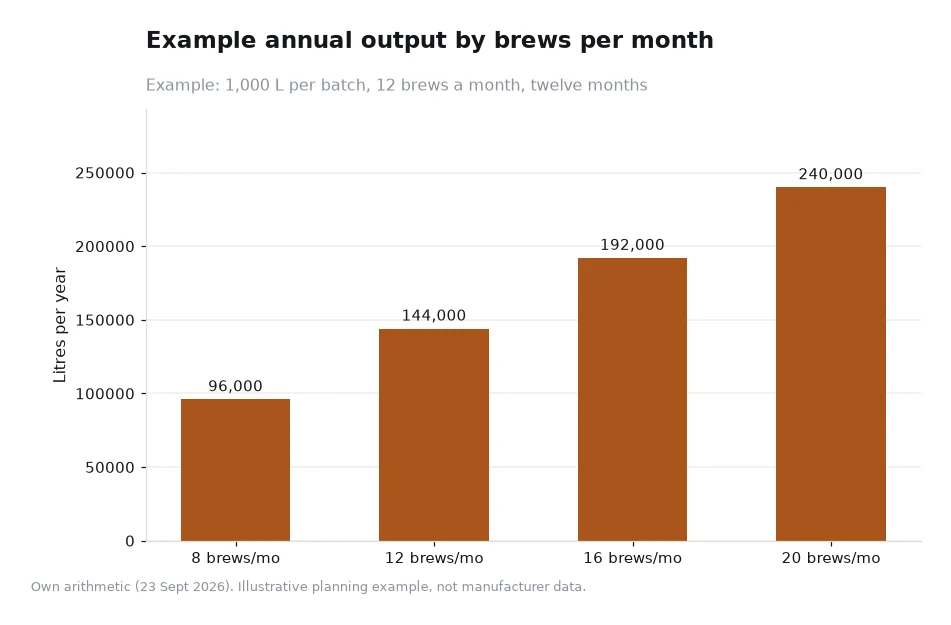
Worked example, with assumptions stated. Take a 1,000 L brewhouse running 12 brews a month, and ask what the 6-year window contains in production rather than in months. Arithmetic: 12 brews multiplied by 12 months gives 144 brews a year, and 144 multiplied by 6 years gives 864 brews inside the published cover period. The chart below uses the same 1,000 L batch: 12 brews a month is 144,000 L a year, the middle bar, against 96,000 L at 8 brews and 240,000 L at 20 brews.
Now put a figure on the parts the wording names. If the electronic components in a small brewery number about 20 items across the control panel, chiller and packaging line, then 864 brews is the workload those items are expected to see inside the cover period. That ratio of items to batches is the reason a duration measured in years is worth reading next to a production plan measured in brews. Both the 864-brew figure and the 20-item count are labelled planning assumptions of mine, not manufacturer data; the 144,000 L annual figure matches the chart.
Frequently asked questions
How long is the warranty on this manufacturer's equipment?
The published wording gives 6 years on tank accessories and electronic components against manufacturing defects from the factory, provided the parts are used within the scope, and it travels with an inspection record and a data plate serial number for each tank.
Does the warranty cover damage during installation?
The published cause in scope is a manufacturing defect from the factory and the condition is use within the scope, so installation damage sits outside that wording and belongs with the installer, which is one reason commissioning by the supplier's own team is published as part of the service.
How to compare warranty sentences properly
Ask every supplier for the same three things in writing: the start date of the cover, the list of parts it applies to, and the evidence required to open a claim. Then match the answer against your own production plan, because a duration measured in years means very different things at 8 brews a month and at 20. The published company profile sets out the manufacturer's experience and export markets, and the brewery equipment range shows which accessories and control items appear on a typical order. For wording specific to your own order, Turn-Key brewery solutions is the manufacturer's own starting point, with the contact details published alongside.
The warranty and service wording quoted here, including the 6-year cover on tank accessories and electronic components against manufacturing defects from the factory, the 7x24 after-sales line, the five inspection steps, the data plate and the 90 to 150 day delivery window, comes from the manufacturer's own website, read 23 Sept 2026.[1] The brews-in-six-years arithmetic is a labelled example written for this page.