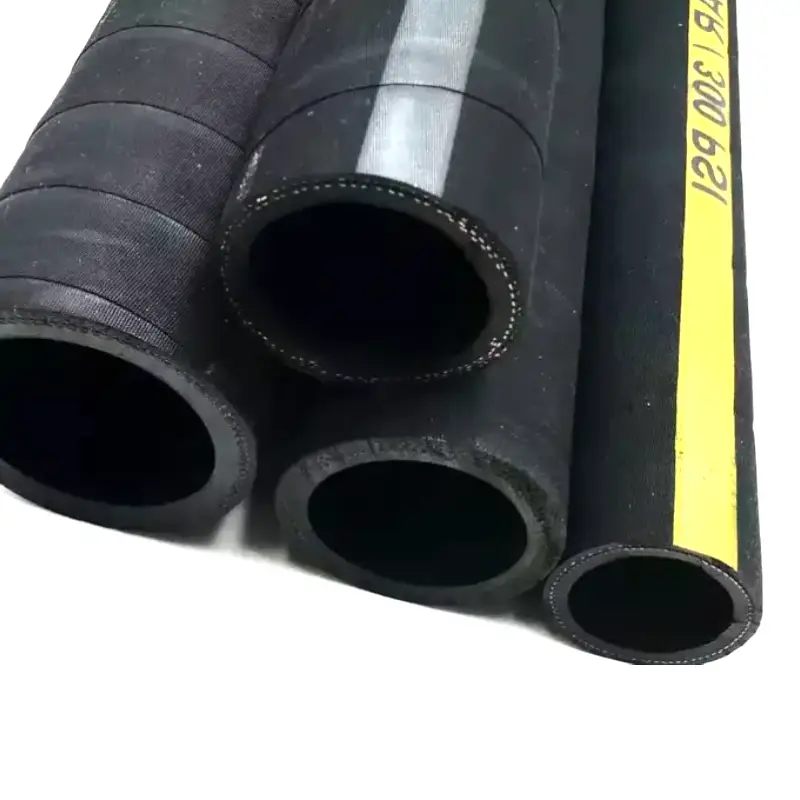
The standard protocol mandates hydraulic hose assemblies to endure 1,000,000 impulse cycles at 133% operating pressure and temperatures reaching 121°C under SAE J517 testing. Achieving structural durability requires 54° 44' neutral-angle wire reinforcement, HNBR synthetic elastomeric compounds, and crimp diameter tolerances held within ±0.05 mm. External abrasion causes 80% of premature field failures, prompting top manufacturers to apply UHMWPE outer layers that increase wear resistance up to 700% over standard rubber.
Modern high-pressure fluid delivery relies on high-tensile steel wire geometry and precise rubber vulcanization. Standard synthetic rubber formulations undergo accelerated polymer degradation when exposed to mineral oils above 100°C, leading to interior micro-cracking within 1,500 continuous operating hours. To extend service life, an experienced hydraulic hose supplier integrates Hydrogenated Nitrile butadiene rubber into the inner tube to resist chemical swelling up to 135°C.
Fluid incompatibility reduces the tensile strength of standard NBR compounds by 35% within 500 hours of continuous exposure to synthetic hydraulic oils.
This chemical stability allows the inner tube to maintain its structural form without flaking particles into hydraulic pumps. To defend against constant ambient ozone and ultraviolet rays in outdoor operations, manufacturers blended 1.5% microcrystalline wax and specific anti-ozonants into the outer cover formulation. Standardized chamber testing in 2023 showed that untreat synthetic covers develop surface cracks within 72 hours of exposure to 50 pphm ozone concentrations.
Anti-ozonant additives migrate continuously to the surface of the cover, building a self-healing barrier against environmental ozone attacks.
Preventing surface degradation protects the internal steel wire layer from moisture ingress and subsequent rust formation. The structural strength of a hose depends on its reinforcement matrix, which uses high-tensile carbon steel wire rated at 2,750 MPa tensile strength. During automated braiding, machinery maintains wire tension within ±1.5 Newtons to eliminate structural loose spots across a continuous 100-meter production run.
| Reinforcement Type | Working Pressure Range | Neutral Angle Tolerance | Impulse Resistance Standard |
| Single-Wire Braid | 100 bar - 250 bar | 54° 44' (±0.5°) | 150,000 cycles minimum |
| Double-Wire Braid | 180 bar - 400 bar | 54° 44' (±0.5°) | 200,000 cycles minimum |
| Four-Spiral Steel Wire | 280 bar - 500 bar | 54° 44' (±0.2°) | 500,000 cycles minimum |
| Six-Spiral Steel Wire | 400 bar - 700+ bar | 54° 44' (±0.2°) | 1,000,000 cycles minimum |
Precise reinforcement geometry eliminates length changes under pressure, preventing localized wire friction and heat buildup. When reinforcement layers are applied at the exact neutral angle of 54° 44', internal fluid pressure distributes equally across longitudinal and radial vectors. Deviating from this angle by just 2 degrees causes up to a 10% reduction in maximum working pressure rating.
Applying four opposing layers of spiralized steel wire reduces inter-wire friction and increases impulse lifespan by over 300% compared to traditional braided configurations.
Controlling wire geometry enables hose assemblies to withstand intense pressure surges generated by hydraulic control valves. Hydraulic pumps generate violent pressure spikes that exceed normal operating levels by up to 50% within 15 milliseconds. To qualify for ISO 6802 standards, manufacturers subject hoses to continuous 1.2 Hz impulse testing while bending the hose 180 degrees over minimum bend radius mandrels.
Modern impulse test benches maintain oil temperatures at 100°C while cycling pressure from 0 to 133% of working load every second.
Passing these severe impulse tests requires continuous vulcanization monitoring to bond the rubber matrix to the steel reinforcement layers. High-speed continuous vulcanization lines utilize infrared sensors to monitor temperature profiles every 0.5 seconds along a 30-meter curing tunnel. Maintaining rubber temperature at 165°C for 18 minutes ensures 98% cross-linking density in the polymer network.
-
Temperature variations during vulcanization exceeding 3°C reduce rubber-to-metal adhesion by 25%.
-
Automated laser calipers scan the outer diameter every 10 milliseconds to verify wall thickness uniformity within ±0.1 mm.
-
Non-destructive ultrasonic testing inspects concentricity across 100% of manufactured hose lengths.
Consistent wall thickness ensures that heavy-duty end fittings crimp evenly without pinching the internal steel reinforcement wires. Precision crimping machinery relies on electronically calibrated die sets to compress metal ferrules onto the hose ends. Crimping dimensions are held to tolerances within ±0.05 mm, securing the fitting against fluid forces exceeding 1,600 bar burst pressures.
Incorrect crimping dimensions cause 65% of hose assembly field detachment failures in mobile construction equipment.
Ensuring tight crimping parameters prevents high-pressure fluids from leaking between the inner tube and the metal fitting. Mechanical abrasion from contact with adjacent machine frames accounts for 80% of external hose failures in field operations. To eliminate premature cover wear, manufacturers apply 0.2 mm UHMWPE film sleeves over the synthetic rubber cover.
Comparative ISO 6945 abrasion testing in 2024 demonstrated that UHMWPE covers sustain less than 0.005 grams of material loss after 100,000 friction cycles, compared to 0.800 grams for standard synthetic rubber.
This low coefficient of friction prevents external wear from exposing internal steel wires to moisture and environmental oxidation. Cold temperature flexibility remains essential for hydraulic equipment operating in arctic environments down to -40°C. Standard synthetic rubber compounds become brittle below -20°C, leading to outer cover cracking when the hose bends during machine movement.
-
Specialized low-temperature polymers incorporate 12% plasticizer additives to retain flexibility at -50°C.
-
Cold-bend testing mandates wrapping conditioned hoses around a test mandrel after 24 hours of exposure at -40°C without forming surface micro-fissures.
-
Ultra-low temperature hydraulic hoses withstand 200,000 flex cycles at -35°C while maintaining full operating pressure.
Maintaining flexibility in freezing conditions prevents micro-fractures that allow moisture penetration and internal reinforcement rusting. Automated optical inspection systems sit directly on production lines to scan every meter of hose for surface defects. Cameras capturing 500 frames per second detect surface pinholes as small as 0.08 mm at production speeds of 30 meters per minute.
Real-time optical inspection removes defective hose sections before reinforcement wrapping, maintaining a 99.8% quality pass rate across bulk manufacturing output.
Removing defects early in production guarantees consistent performance when hydraulic lines operate in high-demand industrial installations.